Tea Tree Oil for Skin Benefits: Uses and What We’ve Learned
This post contains affiliate links. If you buy through our links, we may earn a small commission at no extra cost to you — and it helps keep Forged Family HQ running. We only recommend what we actually use or have researched thoroughly.
It’s 9:47 p.m., the kids are finally down, and you catch your reflection in the bathroom mirror. There it is — a red, angry blemish on your chin the night before a meeting you actually care about.
Or maybe it’s not your face at all. Maybe it’s a scraped knee on a six-year-old who took a corner too fast on the driveway, and the skin around it is starting to look a little too pink. Either way, you’re standing there thinking the same thing a lot of moms think at that exact moment: I do not want to slap something harsh on this.
That’s the moment our family reaches for tea tree oil. Over the years we’ve tested a lot of natural options, and tea tree oil for skin benefits keeps earning a permanent spot in our medicine cabinet. Not because some influencer told us to. Because it has quietly worked, again and again, for the small skin stuff that comes with raising a family.
Here’s what we’ve learned — what it actually does, how we use it on ourselves and on our kids, and where its limits are.
Tea Tree Oil for Skin Benefits (What It Actually Does)
Tea tree oil comes from the leaves of an Australian tree called Melaleuca alternifolia. The reason it works on skin comes down mostly to one compound: terpinen-4-ol — the compound that gives tea tree oil its antimicrobial and anti-inflammatory punch. That’s a fancy way of saying it does two things at once: it kills bacteria sitting on the skin, and it calms down the redness and swelling that come with an irritated spot.
That double action is exactly why people reach for it for acne. Most pimples are driven by two things working together — bacteria that gets trapped in a pore, and the inflammation your body fires off in response. A lot of acne products only handle one side of that equation. Tea tree oil hits both, which is why even small amounts can settle a blemish down overnight.
The same reasoning applies to everyday cuts and scrapes. When skin breaks open, bacteria love to move in, and your skin reacts with redness and warmth. A drop or two of properly diluted tea tree oil helps cut down both — without the burn of hydrogen peroxide or the heaviness of a thick antibiotic cream.
That’s the short version of why it works. The longer version is what’s earned it space on our shelf for years — and below, we’ll walk through how our family actually uses it, the other tea tree oil for skin benefits we’ve come to count on, and what to look for when you buy a bottle.
How Our Family Actually Uses Tea Tree Oil for Skin
Here’s the honest, unedited version of what we do at home. We have three kids, and our approach is different for each member of the family — because skin is different. And tea tree oil for skin is not the only benefit. We also put tea tree in our spray bottle when we’re cleaning with vinegar for deep cleaning.
For my own blemishes: I apply tea tree oil straight, undiluted, directly on the spot with a clean fingertip or a cotton swab. Just a single dab. I do this once at night before bed and once in the morning if it’s still angry. Of all my tea tree oil for face uses, this is the most common one — and by morning two, most blemishes are noticeably smaller. My skin handles it fine.
For my wife and son’s blemishes: They dilute it. A drop of tea tree oil mixed into about a teaspoon of carrier oil, then dabbed on the spot. Their skin is more sensitive than mine, and applying it straight can cause stinging or dryness for them. The diluted version still works — it just takes a little longer and doesn’t leave their skin feeling raw.
For cuts, scrapes, and skin that’s broken open: This is where tea tree oil really earns its keep in our home. After cleaning the area with soap and water, we add a drop of diluted tea tree oil to help keep things from getting infected. It’s our first-line natural antiseptic for the small stuff — bike scrapes, kitchen nicks, the random mystery scratch a kid comes home with.
For our carrier oil: We most often use NOW Foods Sweet Almond Oil. It’s light, absorbs well, and doesn’t leave skin feeling greasy. If almond oil isn’t available — or if there’s a nut allergy concern — coconut oil works as a solid backup. It’s a little heavier and can feel more occlusive, but it gets the job done.
For our kids: Always diluted. Always. Our kids are young enough that their skin is more reactive, and we’d rather take a few extra seconds to mix a drop into almond oil than risk a stinging reaction. The product we often keep in the cabinet for all of this is Organic Tea Tree Essential Oil — small dark bottle, USDA organic, easy to find, and consistent quality.
That’s the whole routine. Nothing fancy. Just the same handful of moves, done again and again, and it works.
What Else We’ve Tried for Skin (and How They Compare)
Tea tree oil isn’t the only natural option in our cabinet. Over the years, we’ve tried several others for skin issues, and each one earned a spot for a different reason. Here’s the honest breakdown:
THAYER’S Witch Hazel — Better for cleaning skin than treating it. We use witch hazel as a gentle toner or to wipe down skin after a long day, but it doesn’t have the punch tea tree oil does for active blemishes or broken skin. Different job, both useful.
Fruit of the Earth Aloe vera gel — Wonderful for cooling and hydrating. If someone in the family gets a sunburn or has dry, irritated skin from cold weather, aloe is the first thing we reach for. But it doesn’t kill bacteria the way tea tree oil does, so it isn’t our go-to for blemishes or open scrapes.
Coconut oil (on its own) — Some families swear by it for skin. We found it messy. It melts on contact, runs everywhere, and felt impractical for spot-treating one little blemish. We still use it as a carrier oil in a pinch, but it’s not our first pick on its own.
Neosporin — We don’t pretend natural always wins. If a wound looks deep, or if the redness around it is spreading, we have no problem reaching for Neosporin. Conventional medicine has its place, especially when something looks like it could turn into a real infection.
The pattern we keep coming back to: each of these has a role, but tea tree oil covers the widest range of small, daily skin situations in our home.
The Tea Tree Oil We Use (and What to Look For)
Tea tree oil is one of those products where quality really does matter. Not all bottles are the same, and the wrong one can make your tea tree oil for skin care routine more frustrating than helpful. Cheap versions can be cut with cheaper oils, oxidized from poor packaging, or come from the wrong species of tree entirely. Here’s what we look for on every label:
- 100% pure, organic — no fillers, no fragrance oils, no “blends”
- Melaleuca alternifolia listed on the label — that’s the species that actually works
- Dark glass bottle — light degrades essential oils over time, and clear bottles are a red flag
- No added scents or carriers — you want straight oil, not a pre-mixed product
We don’t have a single brand we’re loyal to, but here are some solid options we’ve used or that meet every box on our checklist:
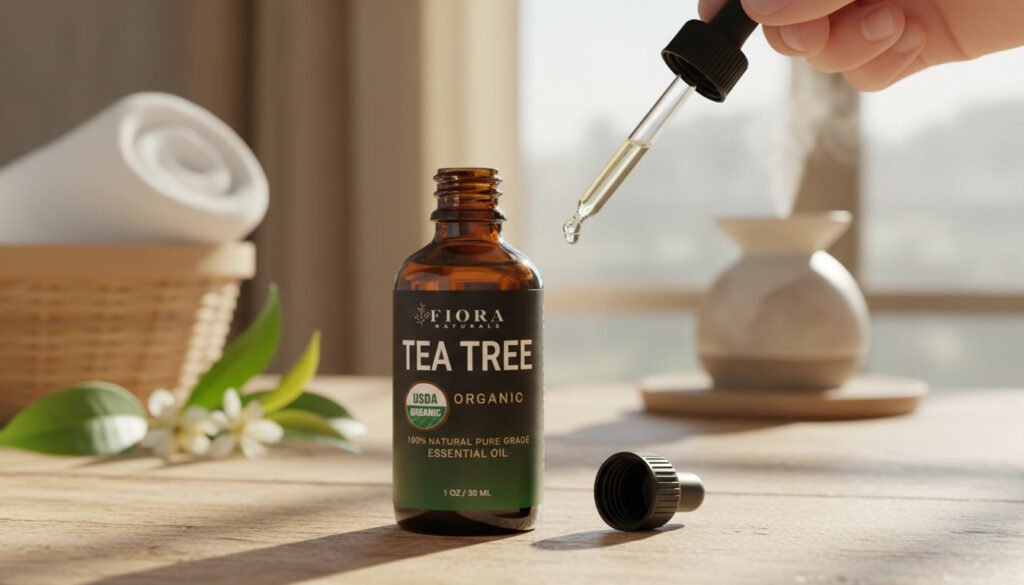
Fiora Naturals Organic Tea Tree Essential Oil
This is our most-reached-for bottle. USDA organic, Melaleuca alternifolia, dark amber glass, and Fiora Naturals essential oils are GCMS tested for purity.
Cliganic USDA Organic Tea Tree Oil
Another solid organic option in a proper dark glass dropper bottle. Honest note: the dropper can drip more than you intend, so go slow.
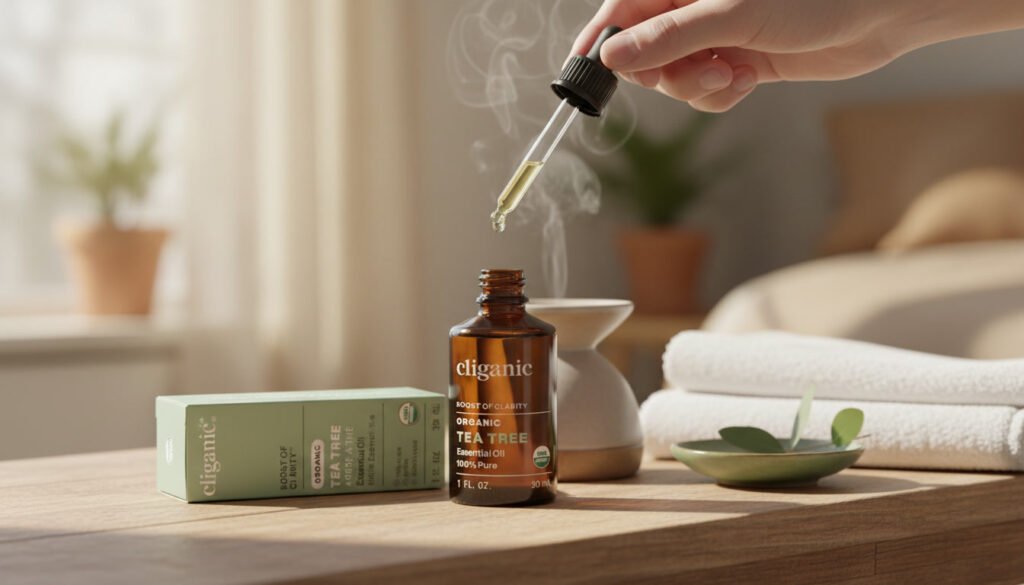
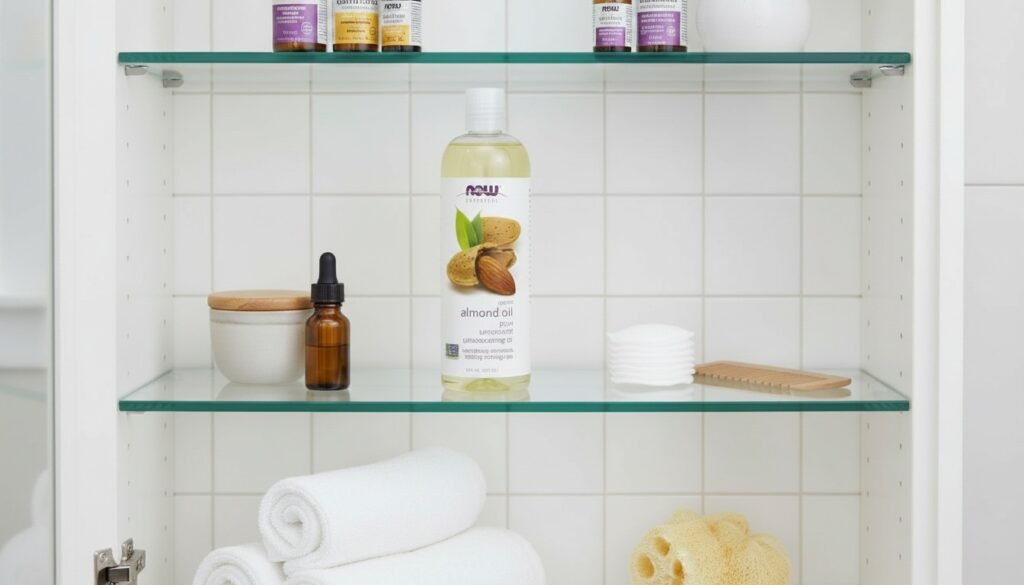
For a carrier oil, we often use NOW Foods Sweet Almond Oil. Light, absorbs well, doesn’t go rancid quickly, and has a long shelf life if you store it in a cool spot.
A Few Things to Know Before You Start
Tea tree oil is gentle compared to a lot of things in the medicine aisle, but it’s still a concentrated essential oil. A few things worth knowing before you put it on your skin or your kid’s skin:
- The smell is strong. Some people love it. Some people don’t. If you’re applying it near your nose or face, expect to notice it for a while.
- Some people have skin sensitivity to tea tree oil, even when it’s diluted. Always do a patch test first — a small dab on the inside of your forearm, then wait 24 hours and watch for redness or itching.
- Never ingest tea tree oil. It is for topical use only. Swallowing it can be toxic.
- Keep it away from your eyes. If it gets near, flush with cool water immediately.
- Always dilute it for children and for sensitive skin areas like the neck, inner arms, or anywhere thin-skinned.
If any of these feel like a wall — especially the patch test result — listen to that. Skin tells you the truth.
When to Skip the Tea Tree Oil and See a Doctor
Tea tree oil is a great tool for small, everyday skin stuff. It is not a substitute for medical care when something serious is happening.
Skip the home remedy and see a doctor if a wound is deep, if you see red streaks moving away from the site, if the area is swelling or hot to the touch, or if a blemish is painful and not improving after several days. Those are signs of a spreading infection, and they need real medical attention — not an essential oil.
When in doubt, call your doctor. Tea tree oil is a first-line support tool, not a replacement for professional care.
Frequently Asked Questions
Q: Can you put tea tree oil directly on your face? A: Some people can, and some people can’t. I apply it straight to a single blemish without a problem, but my wife and son need to dilute it. The safest move is to dilute one drop into about a teaspoon of carrier oil for facial use, especially the first few times you try it. Always patch test first.
Q: Do you need to dilute tea tree oil for skin benefits? A: For most people, yes — especially if you’re applying it over larger areas, on sensitive skin, or on kids. A typical dilution is one drop of tea tree oil to a teaspoon of carrier oil like almond oil. Spot-treating a single blemish on tougher skin is the one place some adults skip dilution.
Q: How quickly does tea tree oil work on acne? A: In our experience, blemishes start looking smaller and less red within 12 to 24 hours of the first application. Some studies have shown it works comparably to common over-the-counter acne treatments, though it tends to be a bit slower and gentler.
Q: Is tea tree oil safe for kids’ skin? A: It can be, but only when properly diluted in a carrier oil and patch tested first. We always dilute for our kids — never straight. The tea tree oil for skin benefits hold up for kids too, but their skin is more reactive, so the safety margin matters. If you’re treating a young child or a baby, talk with your pediatrician before using it.
Q: Can tea tree oil make skin irritation worse? A: It can, if it’s applied undiluted to sensitive skin or if a person has a sensitivity to it. That’s why a patch test matters. If you notice burning, increased redness, or itching after applying it, wash it off and stop using it.
Tea tree oil isn’t a miracle cure. It’s a small, consistent, well-tested tool that has earned a permanent spot in our family’s medicine cabinet — for blemishes, for scrapes, for the everyday skin stuff that doesn’t need a trip to the pharmacy. If you’ve been looking for a gentle, natural option that pulls its weight, the tea tree oil for skin benefits we’ve talked about here are worth trying for yourself.
If you found this helpful, share it with a friend who’s tired of harsh skin products and wants something cleaner that actually works.
We share what works for our family based on our own research and experience. This is not medical advice. Always consult your healthcare provider.